The Walls
Cornelius never saw himself becoming a man who thought about walls.
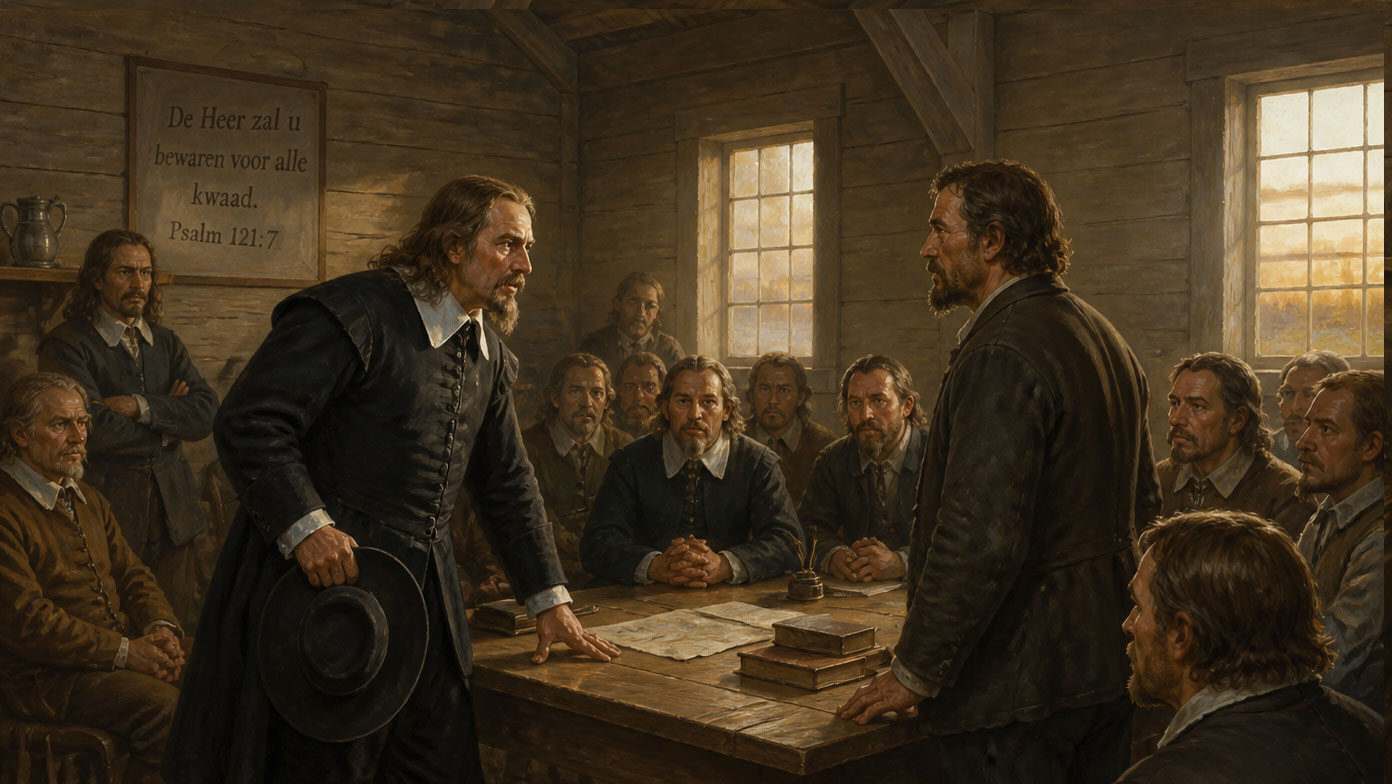
He had come for land and a fresh ledger, not for councils and palisades. Yet there he was in the low‑roofed room, shoulder to shoulder with the other settlers, listening to Peter Stuyvesant tell them what they already knew and what they really didn’t want to hear.
The Director‑General stood near the table, wooden leg planted squarely, hands resting on the head of his cane as if it were a second column. Outside, the wind rattled the shutters. Inside, sweat and wool and damp leather thickened the air.
“One man killed,” Stuyvesant said, “and a few barns burned. This is not yet a war. It is a warning.” His eyes moved over them, sharp and impatient. “You have had warnings before.”
There was a stir at that, a mutter that ran along the wall like whispering grass. Cornelius kept his jaw tight. Warnings. That was one way to name Jacob Adriaensen’s ruined farm, his blinded eye, the child buried in ground that still smelled of smoke.
Stuyvesant tapped the cane once on the floor. “You live scattered like hens across a field. It is convenient for your plowing and inconvenient for your survival. You cannot defend every isolated house. I cannot send soldiers to every hearth.” He paused. “You will gather yourselves into a proper village and enclose it with a stockade, or you will not call on me again.”
A farmer near the door spoke up, hat twisting in his hands. “Director‑General, we are not lazy men. We have fields already half‑sown. The harvest will not wait. If we leave the crops now to cut timber and dig postholes—”
“You will have no harvest if your barns are ash,” Stuyvesant snapped. “I have just come from New Amsterdam. The streets are full of refugees who thought as you do. They left their plows in the furrows and ran for their lives. You have a chance to do better.”
Cornelius watched the room shift under those words. Some faces hardened in resentment; others turned inward, calculating. He felt the familiar tug between seasons: seedtime, harvest, the unrelenting cycle. Timber took time. So did digging ditches, setting posts, hauling earth. Every hour spent with an axe instead of a plow was a wager against the weather and the calendar.
A man from the outlying farms lifted his chin. “If you wish us enclosed, Excellentie, then you will send men and money to do it. We are not rich. The land has barely begun to pay us back for the work we have given it.”
Stuyvesant’s mouth curved, not kindly. “I have sent you fifty soldiers already,” he said. “I can send them away again. As for money—” He spread his hands. “The Company’s purse is not a bottomless sea. If you wish walls, you will help build and pay for them. If you will not, you are free to remove your families to Fort Orange or return to Holland. I am not your nurse.”
The words fell like stones. Cornelius felt them land in his own chest.
He thought of Tryntje’s face when she had described the Esopus man at the neighbor’s bedside, helping himself to beer with no regard for birth or modesty. He thought of standing in Jacob Adriaensen’s yard after the most recent attack, the barn a blackened skeleton, the smell of burned thatch and flesh still clinging to the air. He thought of Jan, restless at fifteen, eyes lighting whenever talk turned to raids and patrols, and of Hendrick just behind him in age—steadier, more inclined to work with his hands than to chase glory, but no less exposed if the fields burned again.
A voice in him said, We have just begun. The brewery is barely established. The mill only lately turning as it should. Where will we find the coin and the hours for this?
Another voice, quieter but steadier, replied: If we do nothing, the question will not be how you pay for walls, but where you bury your dead.
Stuyvesant looked directly at him then, as if sensing the argument.
“Cornelius Barentse Slecht,” the Director‑General said. “You have more to lose here than some. Land. Brewery. A family. You are not a man who runs from difficulty. Will you also stand idle when the difficulty is your town’s safety?”
Heads turned. Cornelius felt the heat rise under his collar. He had not asked to be singled out, but he had also not kept a low profile. Serving as schepen, taking on parish obligations—those choices had stitched his name into the fabric of the place. This was the price.
“We are not idle,” he said slowly. “We have worked these fields, built these houses, brought our families from far away to live here. No man in this room loves the idea of leaving his crops at risk while he swings an axe instead of a scythe.”
Stuyvesant’s gaze did not soften. “And yet?”
Cornelius drew a breath. He thought of the day he had stepped onto the ship in Holland, feeling the lurch as it left the quay. That had been a decision made with his whole weight. This would have to be, too.
“And yet,” he said, letting the words settle, “you are right that we cannot go on as we are. If we live like scattered hens, we will die like scattered hens. The town must have walls.”
A ripple went through the room—some relief, some resentment, some resignation.
The farmer who had spoken earlier shook his head. “Walls are dear,” he said. “Who will pay for them, Cornelius? You? Me? The men from town, or the men in the fields?”
Cornelius did the arithmetic in the space of a breath. Timber, labor, iron for hinges, wages for the few who could not afford to work without them. He saw ledger entries in his mind: barrels of beer not yet sold, loans he might call in, margins he could narrow for a year or two if the harvest cooperated. He saw Tryntje’s face if the harvest did not.
“I will pay what I can,” he said. “More than my strict share. Enough to get the work started and see it finished, if the rest of you will give your hands and time. The stockade will protect my family as it protects yours. I will not ask for safety on credit from other men’s pockets.”
Stuyvesant’s cane thumped once, approvingly. “There,” he said. “That is speech I recognize. You will not regret it, Slecht. Walls once built have a way of paying back their cost.”
Cornelius was not so sure. Walls kept danger out, but they also kept people in. They changed the way a town breathed. Still, the decision was made the moment he spoke it aloud.
After the meeting, as the men spilled out into the sharp daylight, Jan fell into step beside him.
“Is it true?” Jan asked. “You will pay for the stockade?”
“Not for all of it,” Cornelius said. “For more than is comfortable.”
Jan’s eyes were bright, as if the idea of a wall pleased him. “Then we will be like New Amsterdam. A proper town. With gates.”
“With gates,” Cornelius echoed.
“Will I be allowed to help?” Jan pressed. “With the building, I mean. And the watching. I am old enough to stand a turn on the wall.”
Cornelius glanced at him. His son’s shoulders were still narrow under the rough wool, his hands calloused but not yet those of a man. The eagerness in his voice made something twist in Cornelius’s chest.
“We will need every hand we can get,” he said. “For cutting posts, hauling them, setting them. We will talk of watches when the gates stand upright.”
Jan nodded, satisfied for now. “I will be ready.”
Cornelius looked toward the line where the stockade would run, imagining it: heavy timbers, sharpened tops, gates that would swing shut with a final, reassuring thud. It would be work, and cost, and argument. It would also be the difference between sleeping and listening all night for every snapped twig in the dark.
He felt again that same faint shift under his feet he had known on the ship years before—the sense that some current had taken hold beneath his choices, carrying him forward whether he liked the speed or not.
“Come,” he said to Jan. “If we’re to build walls, we’ll need to know how many trees stand straight enough for posts. Your legs are younger than mine. You can do the counting.” Jan grinned and broke into an eager stride toward the edge of the fields. Hendrick, who had been lingering near the doorway, fell in beside his brother without a word, already eyeing the tree line as if measuring it.
Cornelius watched him go, then followed more slowly, feeling the first, invisible weight of the wall he had just promised to raise. It seemed a fair bargain: money and labor in exchange for a measure of safety.
He did not yet know how high the price would climb.